Introduction: Understanding Piston Ring Materials
The right type of piston ring material helps your engine seal the combustion chamber easily. The most commonly used piston ring material across industries is cast iron, particularly ductile iron.
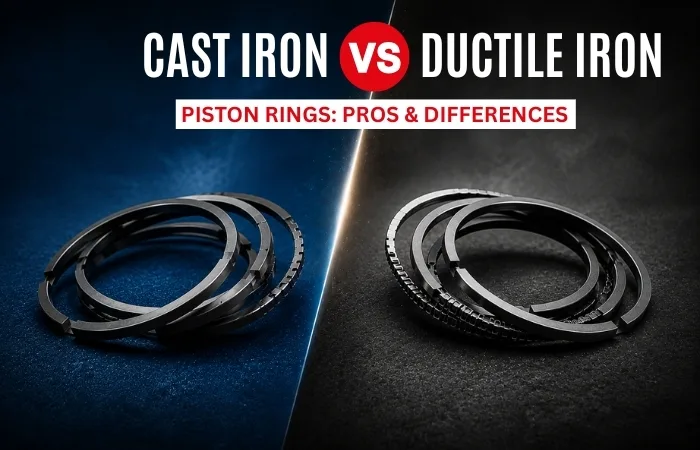
Both Cast iron and ductile iron piston rings have their own advantages and disadvantages, and choosing between them depends on the specific application. This blog will compare cast iron and ductile iron and determine which is better for your business based on strength, wear resistance, applications, and performance.
What is a Cast Iron Piston Ring?
When carbon and silicon are added to melted iron, it makes cast iron. Grey in colour, cast iron is most commonly used to make piston rings. It is mostly known for its low-friction, wear-resistant properties, and ability to withstand high temperatures and speeds.
The hardness of cast iron makes its surface resistant; however, it also makes it fragile and prone to fracture when under pressure. Cast iron is also prone to corrosion, which may cause rust and degradation over time.
What is a Ductile Iron Piston Ring?
Ductile iron is a modern alloy, made by adding small amounts of magnesium to molten iron, causing the graphite to form in nodules rather than flakes. Ductile iron has better mechanical properties, wear resistance, and self-lubricating characteristics. Compared with cast iron, it offers superior strength and durability.
But ductile iron is also more expensive than cast iron due to its more complicated chemical composition.
Cast Iron vs. Ductile Iron Piston Rings
| Feature | Cast Iron Piston Rings | Ductile Iron Piston Rings |
| Material Composition | Made from grey cast iron with flake graphite. | Made from nodular ductile iron with spheroidal graphite. |
| Strength | Good mechanical strength for standard operating conditions. | Higher tensile strength makes it suitable for heavy-duty applications. |
| Wear Resistance | Good wear resistance under normal operating conditions. | Superior wear resistance, especially in high-load and high-speed environments. |
| Flexibility | Comparatively less flexible and more brittle. | More flexible and resistant to cracking due to its ductile structure. |
| Heat Resistance | Performs well at moderate operating temperatures. | Better resistance to high temperatures and thermal stress. |
| Fatigue Resistance | Suitable for regular engine operations but less resistant to repeated stress. | Excellent fatigue resistance makes it ideal for continuous heavy-duty use. |
| Sealing Performance | Provides reliable sealing for standard engines. | Maintains better sealing under high pressure and demanding operating conditions. |
| Machinability | Easier to machine and manufacture. | More difficult to machine due to higher strength but offers better durability. |
| Cost | More economical and widely used in conventional engines. | Slightly more expensive because of its enhanced mechanical properties. |
| Typical Applications | Passenger cars, motorcycles, small engines, and general-purpose industrial equipment. | Commercial vehicles, high-performance engines, reciprocating compressors, marine engines, and heavy industrial machinery. |
| Service Life | Good lifespan under normal operating conditions. | Longer service life in high-pressure and high-temperature applications. |
People Also Read: What Causes Piston Rings to Wear Out Fast?
Advantages of Cast Iron Piston Rings
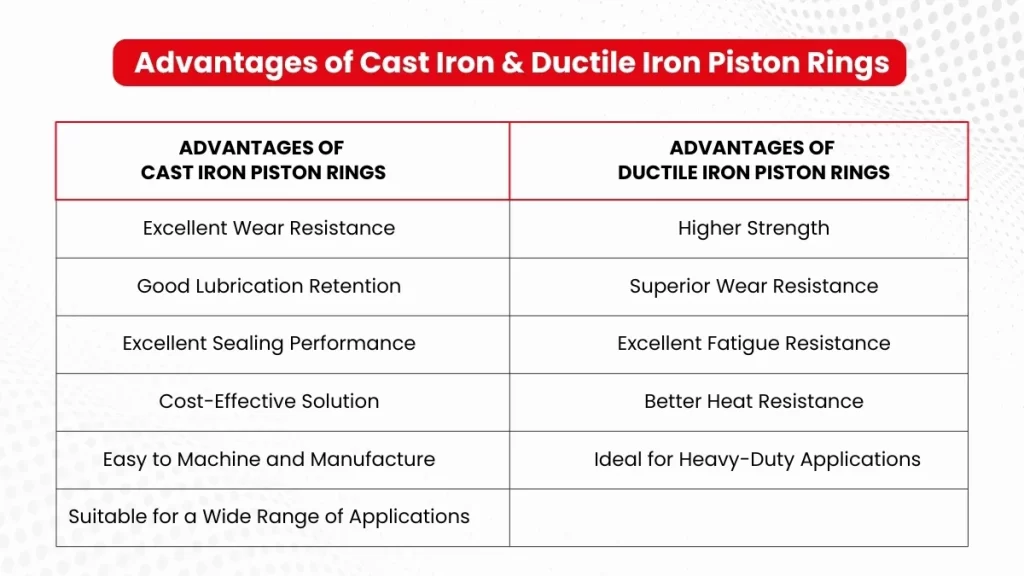
Here are some advantages of cast iron piston rings:
1. Excellent Wear Resistance
Cast iron provides excellent wear resistance under normal operating conditions, helping maintain reliable machine performance over time.
2. Good Lubrication Retention
The graphite present in cast iron provides natural lubrication, reducing friction between the piston ring and cylinder wall and minimizing wear.
3. Excellent Sealing Performance
Other than lubrication, the graphite in cast iron also creates an effective seal between the piston and cylinder wall, preventing gas leakage and maintaining proper engine compression.
4. Cost-Effective Solution
Cast iron is more economical than ductile iron, making it cost-effective for standard automotive and industrial applications.
5. Easy to Machine and Manufacture
Cast iron is easier to cast and machine, allowing manufacturers to produce precision-engineered piston rings with consistent quality and dimensional accuracy.
6. Suitable for a Wide Range of Applications
Cast iron piston rings are more widely used in different applications such as passenger vehicles, motorcycles, small engines, compressors, and various industrial machines.
Advantages of Ductile Iron Piston Rings
Here are some advantages of ductile iron piston rings:
1. Higher Strength
Ductile iron has greater tensile strength than conventional cast iron, making it suitable for high-pressure and heavy-duty machine applications.
2. Superior Wear Resistance
Ductile iron provides superior resistance compared to cast iron and can withstand continuous friction and harsh operating conditions, resulting in a longer service life and reduced maintenance.
3. Excellent Fatigue Resistance
The nodular graphite structure of ductile iron provides fatigue resistance and work more efficiently.
4. Better Heat Resistance
Ductile iron performs well at high operating temperatures, helping maintain its strength and sealing performance even under extreme conditions.
5. Ideal for Heavy-Duty Applications
These are widely used in commercial vehicles, high-performance engines, reciprocating compressors, marine engines, and industrial machinery where reliability and long service life are critical.
People Also Read: Why is it Important to Install the Top Compression Ring Last?
Which Material Should You Choose?
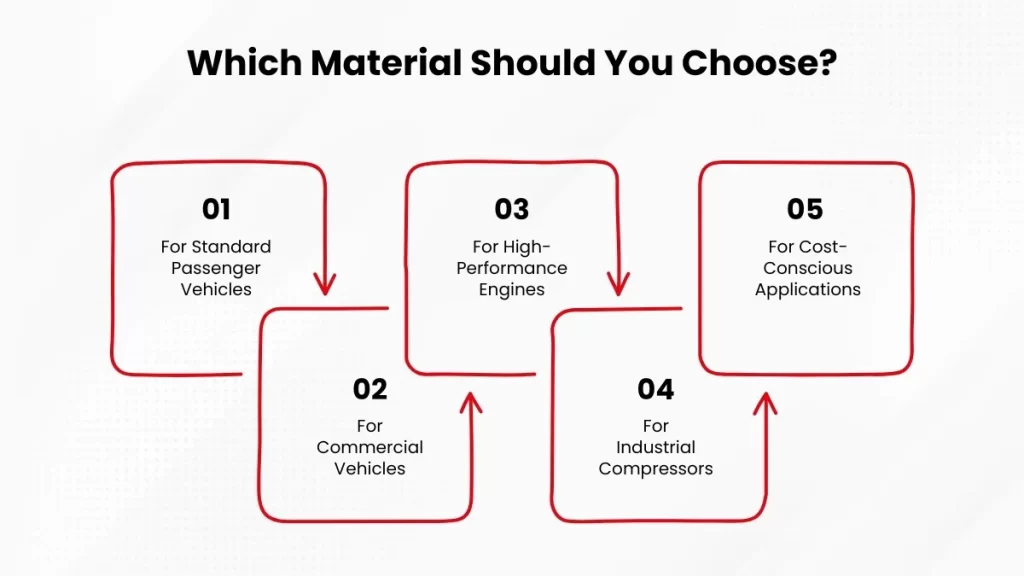
The type of material you should choose between cast iron and ductile iron for your piston ring depends on your use. While both offer advantages, one is better than the other for some specific applications.
1. For Standard Passenger Vehicles
Cast iron piston rings are better for standard passenger vehicles because they provide reliable sealing, good wear resistance, and are cost-effective.
2. For Commercial Vehicles
For Commercial vehicles such as trucks and buses, ductile iron piston rings are used as they can handle more wear and heat for long durations.
3. For High-Performance Engines
Ductile iron piston rings offer superior wear resistance and sealing performance, making them an ideal option for high-performance engines.
4. For Industrial Compressors
Reciprocating compressors operate under continuous pressure and high temperatures. Ductile iron piston rings provide excellent wear resistance and long service life, ensuring reliable compressor performance.
5. For Cost-Conscious Applications
If the application involves moderate operating conditions and budget is a key consideration, cast iron piston rings offer a dependable and economical solution without compromising performance.
Conclusion: Cast Iron Vs. Ductile Iron Piston Rings
Both cast iron and ductile iron offer advantages for different applications. Cast iron is better for standard passenger vehicles and industrial applications due to its cost-effectiveness. On the other hand, ductile iron is better for heavy-duty engines, reciprocating compressors, and high-performance industrial machinery.
Choosing the right piston ring depends on your selected application. Selecting the appropriate piston ring material can significantly improve engine efficiency, reduce wear, and extend the service life of your equipment.
If you’re looking for high-quality cast iron or ductile iron piston rings, Kolbenring India manufactures precision-engineered solutions designed to deliver exceptional performance across automotive and industrial applications. Contact Kolbenring India today to find the right piston ring material for your specific requirements and ensure reliable, long-lasting performance.
FAQs: Cast Iron Vs. Ductile Iron Piston Rings
1. What is the difference between cast iron and ductile iron rings?
Ans: Cast iron offers low friction, wear resistance, and high-temperature tolerance, but it is prone to fracture and rust. Ductile iron rings have better wear resistance, mechanical strength and self-lubrication. Also, ductile iron rings cost more due to their better performance and nodular shape.
2. Which piston rings are best?
Ans: The best piston ring depends on its use. Ductile iron rings are better for high-performance and heavy-duty equipment, while cast iron rings are better for day-to-day use.
3. What are the three types of piston rings?
Ans: The three types of piston rings are compression rings, wiper rings, and scraper rings.