Introduction: Understanding 2-Stroke and 4-Stroke Engines
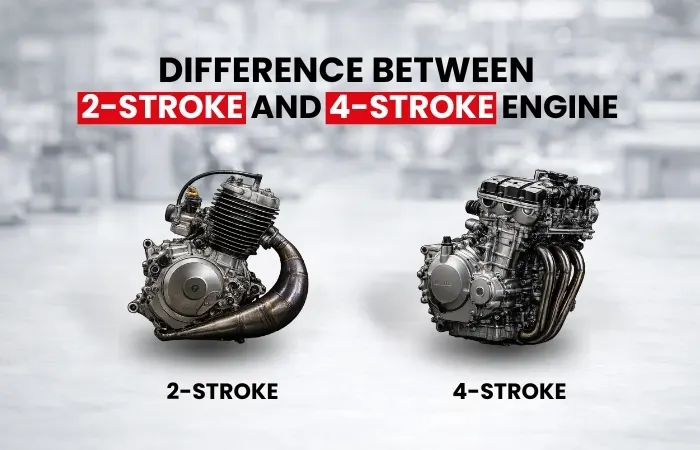
There are two primary types of internal combustion engines: two-stroke and four-stroke engines. Both of these engines sound quite similar but provide very different features, making it essential to understand their differences.
In this blog, we will discuss the difference between 2-stroke and 4-stroke engines, their workings, advantages, disadvantages, and applications.
What is a 2-Stroke Engine?
Let’s first understand what a 2-stroke engine is. A 2-stroke engine completes its power cycle in just two piston strokes, with compression and ignition on the upstroke and power and exhaust on the downstroke.
It is more efficient and powerful than its 4-stroke counterpart; it also runs hotter, and components wear down more quickly. 2-stroke engines are commonly used in motorcycles, scooters, chainsaws, lawn equipment, outboard motors, and other small machines where compact size and lightweight operation are important.
What is a 4-Stroke Engine?
A 4-stroke engine is a type of internal combustion engine that completes one power cycle in four separate piston strokes: intake, compression, power, and exhaust.
This is a more complex design than the 2-stroke engine, with additional components such as valves and a dedicated lubrication system. This design helps improve fuel efficiency, reduce emissions, and extend the engine’s lifespan.
4-stroke engines are widely used in cars, trucks, buses, generators, agricultural equipment, and industrial machinery. They are the preferred choice for applications that require consistent performance, better fuel economy, and long-term durability.
People Also Read: Compression Rings and Oil Rings: Pros, Cons, & Best Practices
Working Process of a 2-Stroke Engine
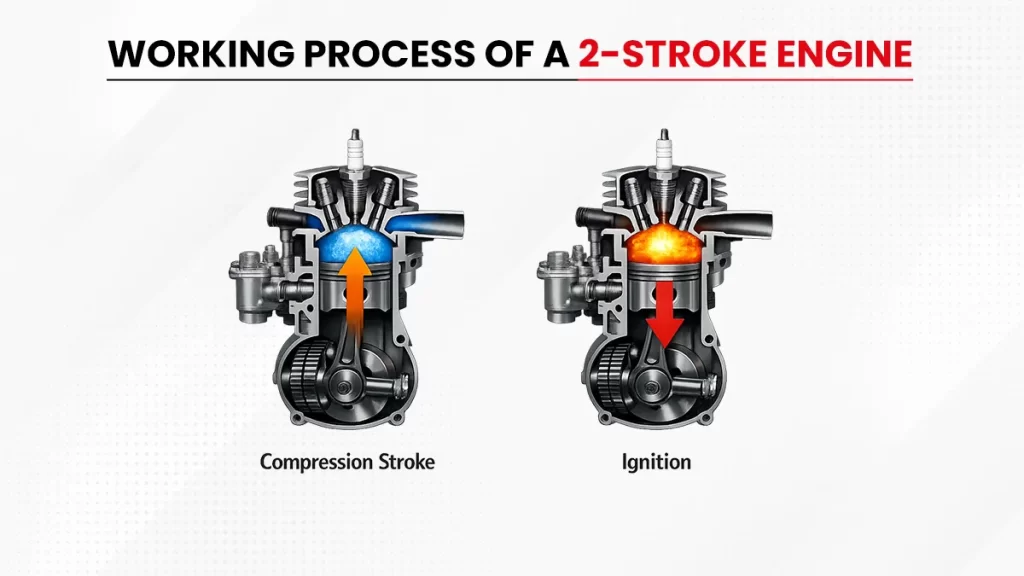
The process consists of the following two stages:
Compression Stroke
During the upward movement of the piston, the air-fuel mixture inside the combustion chamber is compressed, while a fresh air-fuel mixture enters the crankcase through the intake port. When the piston reaches the top of the cylinder, the compressed mixture is ready for ignition.
Ignition
A spark plug ignites the air-fuel mixture, creating a controlled explosion that forces the piston down and generates power. As the piston moves down, it uncovers the exhaust port, allowing burnt gases to exit the cylinder. Simultaneously, the fresh air-fuel mixture from the crankcase enters the cylinder through the transfer port, preparing the engine for the next cycle.
Working Process of a 4-Stroke Engine
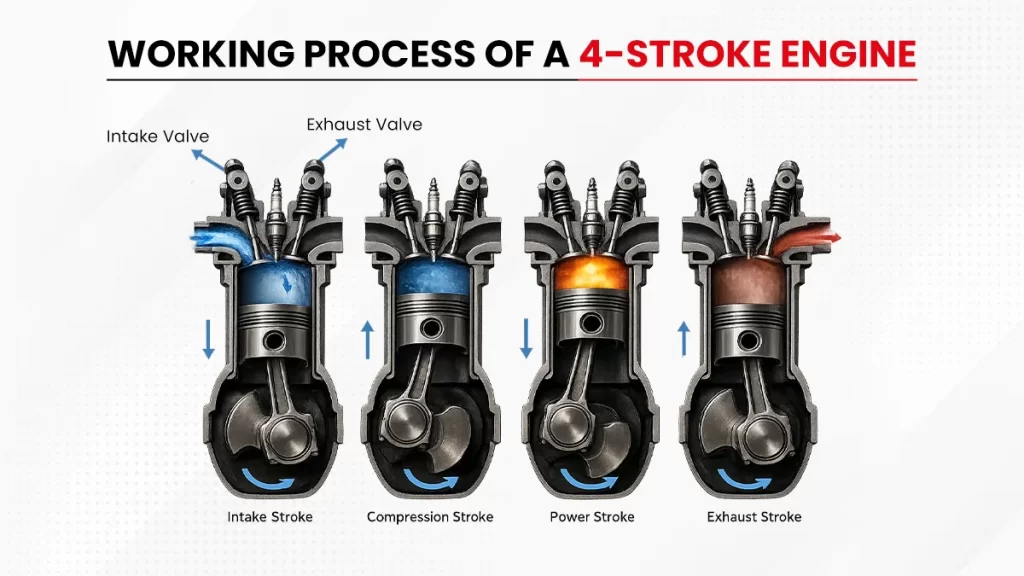
The Process of a 4-stroke engine consists of 4 stages:
Intake Stroke
In the intake stroke, the piston moves downward while the valves open, creating a vacuum in the cylinder that draws the air-fuel mixture into the combustion chamber.
Compression Stroke
After moving down in the intake stroke, the piston now moves upward and compresses the air-fuel mixture. This helps the mixture increase its pressure and temperature, preparing it for efficient combustion.
Power Stroke
Then, at the top of the compression stroke, the spark plug ignites the compressed air-fuel mixture in petrol engines, while diesel engines ignite fuel through compression heat, resulting in combustion forcing the piston downward, generating power that drives the crankshaft.
Exhaust Stroke
After the power stroke, the exhaust valve opens, and the piston moves upward again. This pushes the burnt gases out of the cylinder through the exhaust port, clearing the chamber for the next intake cycle.
Key Differences Between 2-Stroke and 4-Stroke Engines
| Feature | 2-Stroke Engine | 4-Stroke Engine |
| Working Cycle | Completes in 2 strokes | Completes in 4 strokes |
| Power Output | Higher power | Lower power |
| Fuel Efficiency | Lower fuel efficiency | Higher fuel efficiency |
| Maintenance | Requires more maintenance | Longer lifespan |
| Lubrication | Oil mixed with fuel | Separate lubrication system |
| Emissions | Higher emissions | Lower emissions |
| Applications | Small machines | Cars & industrial use |
People Also Read: Differences Between Piston Ring and Rider Ring
Advantages of 2-Stroke and 4-Stroke Engines
Advantages of a 2-Stroke Engine
- Simple Design: The 2-stroke engine has fewer parts and does not require complex valve mechanisms, making it easier to operate and maintain compared to a 4-stroke engine.
- Lightweight and Compact: Due to its construction and components, the 2-stroke engine is smaller and lighter than a comparable 4-stroke engine, making it ideal for portable equipment and small vehicles.
- Higher Power-to-Weight Ratio: Since a power stroke occurs during every crankshaft revolution, 2-stroke engines generate more power relative to their size and weight.
- Lower Manufacturing Cost: The 2-stroke engines are simpler to make than the 4-stroke engines, and it is less expensive to produce, making them a cost-effective option for many applications.
- Quick Acceleration: The frequent power strokes allow 2-stroke engines to respond quickly and deliver rapid acceleration, which is beneficial in motorcycles, chainsaws, and other lightweight machinery.
Advantages of a 4-Stroke Engine
- Better Fuel Efficiency: A 4-stroke engine uses fuel more efficiently because each stage of the combustion process is separated. This results in lower fuel consumption compared to a 2-stroke engine.
- Lower Emissions: The controlled combustion process and separate lubrication system help reduce harmful exhaust emissions, making 4-stroke engines more environmentally friendly.
- Longer Engine Life: With a dedicated lubrication system and less wear on internal components, 4-stroke engines generally last longer and require fewer major repairs.
- Smoother and Quieter Operation: These engines run more smoothly and produce less noise due to their balanced combustion cycle and advanced design.
- Lower Maintenance Requirements: Since engine oil is stored separately from the fuel, internal components receive better lubrication, reducing wear and minimizing maintenance needs over time.
Disadvantages of 2-Stroke and 4-Stroke Engines
Disadvantages of a 2-Stroke Engine
- Higher Fuel Consumption: 2-stroke engines consume more fuel than 4-stroke engines, as they produce a power stroke with every crankshaft revolution.
- Higher Emissions: Since fuel and lubricating oil are often mixed together, some unburnt fuel can escape during operation, resulting in higher exhaust emissions and increased pollution.
- More Wear and Tear: The continuous combustion cycle and simpler lubrication system cause engine components to wear out faster, reducing the overall lifespan of the engine.
- Frequent Maintenance Requirements: Due to increased wear on internal parts, 2-stroke engines typically require more frequent maintenance and component replacement.
- Noisier Operation: 2-stroke engines are noisier and produce more vibration during operation, which may affect user comfort in certain applications.
Disadvantages of a 4-Stroke Engine
- More Complex Design: A 4-stroke engine has more components than a 2-stroke engine, such as valves, camshafts, and a separate lubrication system, making it more complex to manufacture and repair.
- Heavier in Weight: 4-stroke engines are usually heavier with a similar power output, due to the extra components added in it.
- Higher Initial Cost: The initial cost of the 4-stroke engine is higher as it has more components, increasing its overall manufacturing cost.
- Lower Power-to-Weight Ratio: Since a power stroke occurs only once every two crankshaft revolutions, 4-stroke engines produce less power relative to their size and weight compared to 2-stroke engines.
- More Components to Maintain: The 4-stroke engine has more parts that may require inspection, adjustment, or replacement over time, which can increase repair complexity.
Importance of High-Quality Engine Components
Both 2-stroke and 4-stroke engines work under high heat and pressure, which makes it very important for them to have high-quality components that would help them stay consistent and not wear out. Parts such as piston rings, oil seals, cylinders, and bearings operate under high temperatures, pressure, and constant friction.
High-quality engine components ensure proper sealing, smooth operation, and effective heat transfer within the engine. This is why choosing components from a trusted manufacturer is important. Companies like Kolbenring India are known for producing precision-engineered piston rings designed to meet demanding automotive and industrial requirements.
Conclusion: Difference Between 2-Stroke and 4-Stroke Engines
The engine of any machine works as the brain of the machine, which is why it is very important to make the machine work properly. Knowing the difference between a 2-stroke and a 4-stroke engine helps in selecting the right option based on performance requirements, operating conditions, and maintenance considerations.
Regardless of the engine type, the quality of internal components plays a crucial role in ensuring reliable performance and durability. High-quality piston rings, oil seals, and other engine parts help reduce wear, improve efficiency, and extend engine life.
If you are looking for precision-engineered piston rings, Kolbenring India offers trusted solutions designed for demanding automotive and industrial applications. Contact Kolbenring India today to learn more about our high-performance products and find the right solution for your engine requirements.
FAQs: Difference Between 2-Stroke and 4-Stroke Engines
1. Which is better, a 2-stroke or 4-stroke engine?
Ans: Both 2-stroke and 4-stroke engines are better for their reasons; the 2-stroke engine provides better performance and power, while the 4-stroke engine provides better fuel efficiency.
2. Is a 4-stroke engine the same as a 2-stroke engine?
Ans: No, a 4-cycle (4-stroke) and a 2-stroke engine are not the same. The main difference is how the engine completes the combustion cycle. A 4-stroke requires four movements of the piston to complete one cycle, while a 2-stroke does it in two.