Introduction: Understanding Reciprocating Compressors
Reciprocating compressors are a crucial part of the refrigeration and manufacturing industries. These compressors are used in many industries where gases need to be compressed to high pressures.
These compressors are mainly recognized for their reliability, efficiency, and ability to handle demanding operations. Understanding what a reciprocating compressor is, how it works, and its types is essential for ensuring optimal performance and long-term durability.
What is a Reciprocating Compressor?
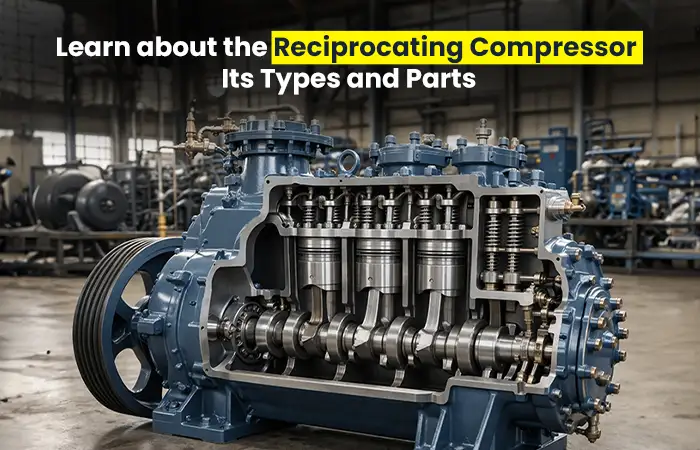
A reciprocating compressor is a machine that uses a crankshaft-driven piston moving back and forth within a cylinder to compress gases. This type of compressor is widely used in industries that require high-pressure gas output, such as refrigeration systems, gas pipelines, chemical plants, and manufacturing units.
Reciprocating compressors are known for their robust design, high efficiency, and ability to handle a wide range of gases, making them an essential component in many mechanical and industrial systems.
How Does a Reciprocating Compressor Work?
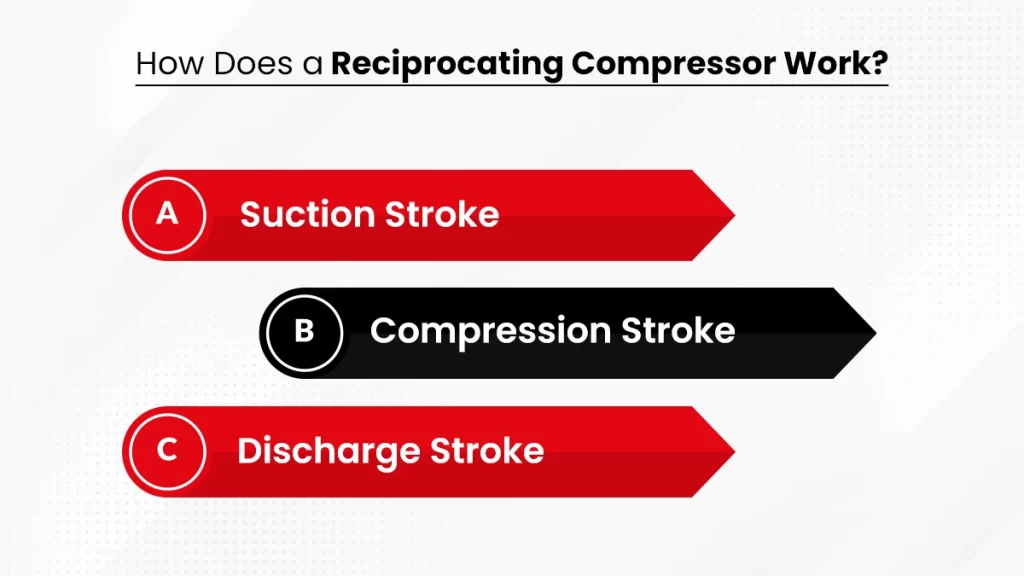
After understanding what a reciprocating compressor is, it is important to know how it works. Here is a step-by-step process of how it works:
1. Suction Stroke
During this stage, the piston moves downward inside the cylinder, creating a vacuum. This allows the suction valve to open, and gas enters the cylinder from the inlet.
2. Compression Stroke
As the piston moves upward, the suction valve closes, and the gas inside the cylinder is compressed. The pressure and temperature of the gas increase as the piston reduces the volume inside the cylinder.
3. Discharge Stroke
Once the gas reaches a certain pressure, the discharge valve opens. The compressed gas is then pushed out of the cylinder into the delivery system for further use.
People Also Read: Process of a Continuous Casting Machine
Main Parts of a Reciprocating Compressor
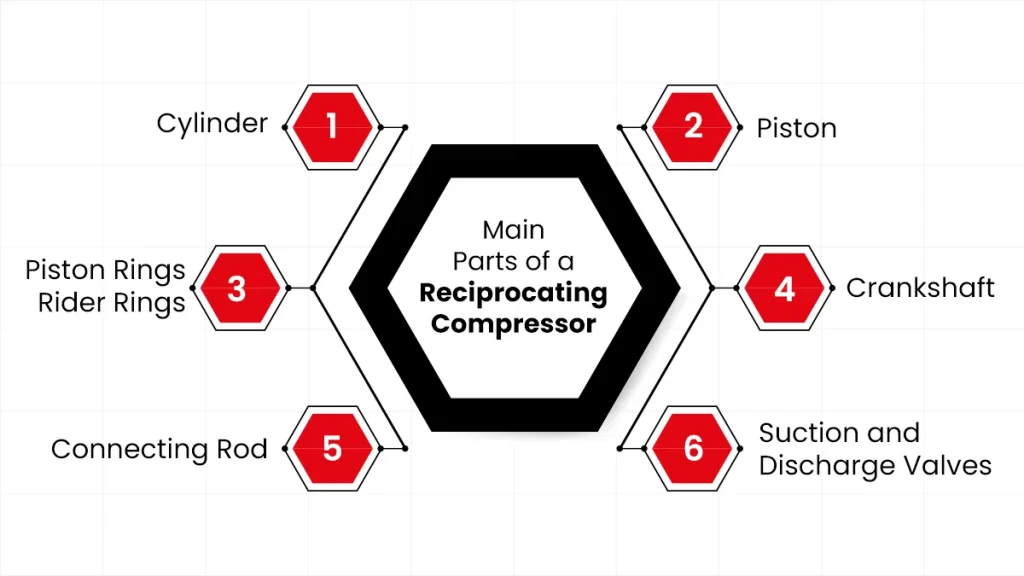
After understanding the process of a reciprocating compressor. Here are the main parts used to make it. These parts help it to work smoothly and efficiently.
1. Cylinder
The cylinder is the main component where gas compression occurs. It holds the piston and provides a space where gas enters, gets compressed, and then exits.
2. Piston
The piston inside the cylinder moves up and down, creating the pressure needed to compress the gases.
3. Piston Rings/Rider Rings
Piston rings are the rings inside the piston that create a tight seal between the piston and the cylinder wall. They prevent gas leakage, maintain compression efficiency, and help transfer heat.
4. Crankshaft
The crankshaft helps the reciprocating compressor convert from rotational motion to reciprocating motion.
5. Connecting Rod
The connecting rod links the piston to the crankshaft. It transfers motion and force, allowing the piston to move up and down smoothly.
6. Suction and Discharge Valves
These valves control the flow of gas into and out of the cylinder. The suction valve allows gas to enter, while the discharge valve releases compressed gas at high pressure.
Types of Reciprocating Compressors
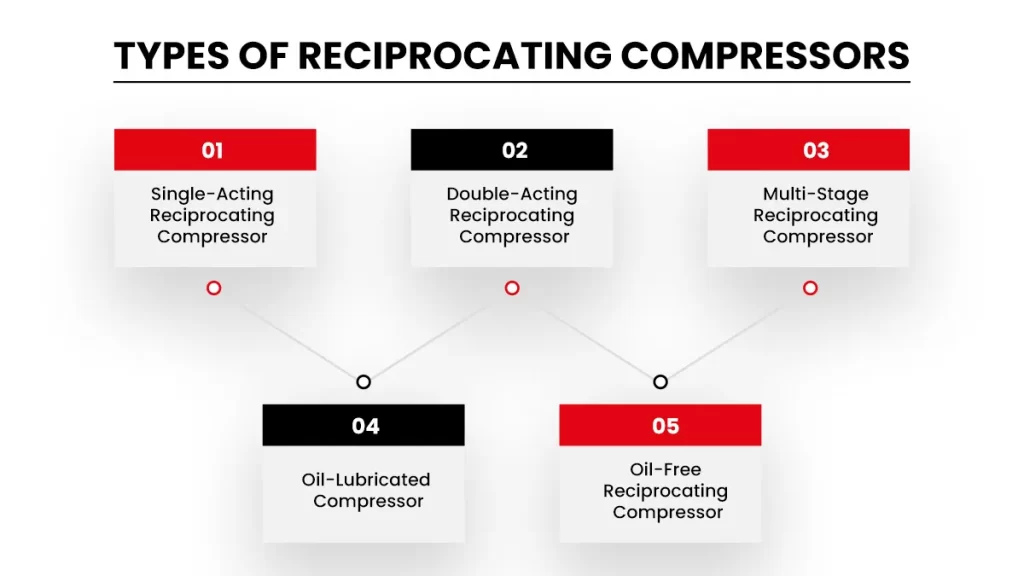
Here are the types of reciprocating compressors:
1. Single-Acting Reciprocating Compressor
This type of compressor takes place only on one side of the piston. The gas enters the piston and is compressed during one stroke, making the design simpler and suitable for smaller applications.
2. Double-Acting Reciprocating Compressor
The double-acting reciprocating compressor compresses gas on both sides of the piston, increasing efficiency and output, majorly used in heavy-duty industrial applications where higher capacity is required.
3. Multi-Stage Reciprocating Compressor
The multi-stage reciprocating compressor compresses gases in multiple steps using more than one cylinder, which helps achieve higher pressure levels while reducing the load on each stage and improving efficiency.
4. Oil-Lubricated Compressor
These compressors use oil for lubrication to reduce friction and wear between moving parts. They are widely used in industrial settings where durability and continuous operation are important.
5. Oil-Free Reciprocating Compressor
Oil-free compressors do not use lubrication in the compression chamber, making them ideal for applications that require clean, contamination-free air or gas, such as food processing or medical industries.
People Also Read: Common Reciprocating Compressor Problems and How to Fix Them
Why Choosing High-Quality Components Matters?
The reciprocating compressor performs under high pressure, excessive heat, and continuous motion, making it important to have high-quality components. Parts like piston rings, valves, and cylinders must withstand constant stress while maintaining efficiency.
High-quality components are designed with precision and made from durable materials that ensure proper sealing, smooth operation, and minimal friction. This not only improves the overall efficiency of the compressor but also helps in reducing maintenance costs and downtime.
Companies like Kolbenring India, known for their precision engineering and durable solutions, provide high-performance components that enhance the reliability and lifespan of reciprocating compressors.
Conclusion: Importance of the Reciprocating Compressor
Reciprocating compressors are an essential part of many industrial and commercial applications, known for their ability to deliver high-pressure gas reliably and efficiently. By understanding how these compressors work, their key components, and the different types available, industries can ensure better performance, reduced downtime, and longer equipment life.
Proper maintenance and the use of high-quality components play a critical role in keeping reciprocating compressors running smoothly. If you are looking for reliable and high-performance components for your compressor systems, Kolbenring India offers trusted solutions designed for demanding applications.
Get in touch with Kolbenring India today through our Contact Us page to find the right components and ensure long-lasting performance for your equipment.
FAQs: Understanding Reciprocating Compressors
1. What are the parts of a reciprocating compressor?
Ans: A reciprocating compressor has a cylinder, piston, piston ring, crankshaft, connecting rods, and valves.
2. What are the types of reciprocating compressors?
Ans: A reciprocating compressor has 5 types:
- Single-Acting Reciprocating Compressor
- Double-Acting Reciprocating Compressor
- Multi-Stage Reciprocating Compressor
- Oil-Lubricated Compressor
- Oil-Free Reciprocating Compressor