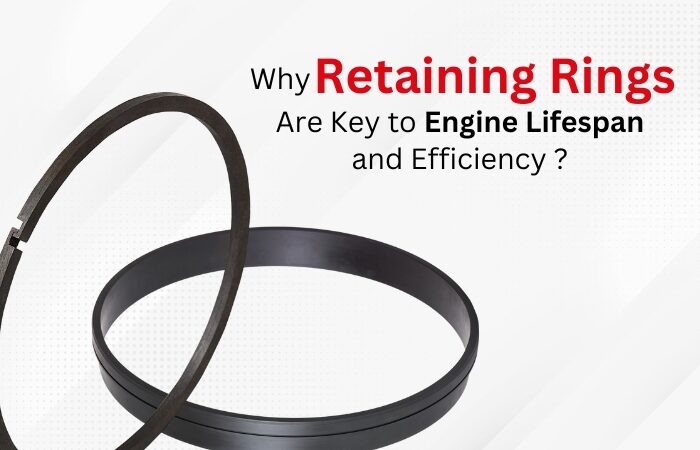
Why Retaining Rings Are Key to Engine Lifespan & Efficiency
Introduction
As fragile and minimal as they might look, retaining rings are as crucial for an engine’s resilient performance as the engine block, combustion chamber, pistons, etc.
Sturdy retention rings hold the mechanical units together, preventing damage by restricting unnecessary movements within the subassemblies and ensuring smooth operation of the entire process.
What Are Retaining Rings?
These metal rings are pivotal, as they hold the assemblies together in an engine. They are circular fasteners that hold the subassemblies together in a mechanical unit for smooth functioning and increased efficiency.
An engine’s smooth functioning and durability depend on retaining rings, so the rings must be tenaciously reliable. They secure the engine’s parts during intense pressure areas, and only robust retention rings can withstand all the fluctuating environments.
These fastening rings have two types. Both are fasteners that secure the parts and structurally support the overall assembly.
- Internal Rings: Internal rings fasten the assemblies from inside a cylindrical chamber. They hold the assemblies together and prevent them from moving outwards.
- External Rings: On the other hand, external rings hold the assemblies from outside the cylindrical shafts.
People also read: Piston Ring Industry in India 2025 | Market Growth & Demand
Importance of Retaining Rings in Engines
As fasteners, these rings are equally crucial for engines, like other functioning components. They provide support to the structure by securing the units together.
Rings allow all the necessary movements of the assembly by anchoring the subassemblies so they don’t move dependently. They keep the mechanical sections intact even under rigorous conditions, which makes them a crucial part of an engine.
Retaining Rings in Extreme Conditions
Retention rings must be durable and able to stay put while performing heavy-duty tasks, as they handle heat, pressure, and vibrations. They must be resilient enough to withstand extreme temperatures and pressure. Also, shakes and tremors must not interfere with their positioning frequently.
As these rings face continuous high-demand operations, they must be made of durable materials like stainless or carbon steel. Only high-quality materials can ensure the endurance of these securing rings and hence the improved operational life of the mechanical parts they are anchoring.
Choosing the Right Retaining Ring
To get the maximum out of our engines, we must be sure that all the parts fit together, and we can achieve this with perfectly sized fasteners. The size, fit, and material for the engine should be accurately measured before setting up the assemblies to get the best performance from the mechanical unit.
Consulting experts for suggestions and tips on choosing the correct retention fasteners can save a lot of money and time by not having to get the engines checked more frequently than required.
Maintenance Tips
As these retention rings are pivotal parts of the engine and hold the sub-assemblies together, it is crucial to make sure they are regularly checked for signs of wear and tear.
The rings might become loose, making it difficult for the machinery to perform up to standard. They keep the assembly intact in the harshest conditions, so they also come into contact with various environments, which makes them prone to rust or damage.
These fastening rings tend to lose their grip over time. That is why, just like major sections of an engine, it is essential to check on the rings periodically, as a loose or worn-out fastening ring not only affects the performance but also might damage the overall mechanical structure.
Checking on the rings in a timely manner also helps you spot the missing or loose rings and gives you time to replace them before they can further cause impairment in the assembly.
Conclusion
In conclusion, retaining rings are more than just fasteners. They secure the mechanical units, and we can rely on them regarding the calculated movements of our assemblies.
As sturdy as they can be, it is also necessary to check on them frequently for the long life of the engines. They must fit around the shafts or bores to properly function the mechanical units.
It is preferred to go for the brands trusted by industry experts for choosing the proper retention fasteners. As durable mechanical parts save our time and our engines, it is wise to invest in reliable manufacturers who use premium-quality material and the latest techniques for sturdy retaining rings.
If you want to know more about Retaing Rings, then contact Kolbenring India now!
FAQs
1. What does a retainer ring do?
A retaining ring is a fastener designed to secure components or assemblies onto a shaft or inside a housing or bore by fitting into a groove. It is generally intended for single-use applications.
2. When to use a retaining ring?
Retaining rings are used to secure components in place on a shaft or within a bore.
3. How to choose a retaining ring?
Key Factors When Choosing a Retaining Ring:
- Free Diameter: Outer diameter for internal rings; inner diameter for external rings.
- Thickness: Must match groove dimensions for a secure fit.
- Groove Size: Includes diameter, width, and depth for proper seating.
4. How to remove a retaining ring?
The most common way to remove a retaining ring is by using snap ring pliers—insert the tips into the ring’s holes, squeeze to expand or compress it, and gently lift it out of the groove.